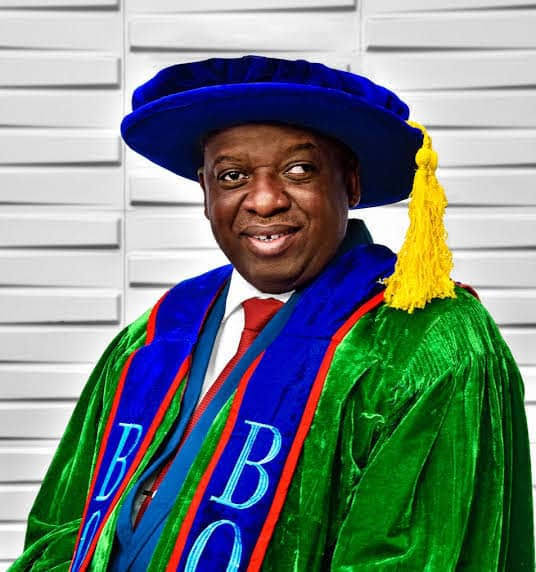
Photo : Prof Joshua Ogunwole, Vice-Chancellor, FUOYE
By: Daniel Kanu
In the often turbulent terrain of Nigeria’s higher education system, progress is rarely accidental.
It is the product of vision, discipline, and sustained leadership. At the Federal University Oye-Ekiti, that leadership has, in recent years, been embodied by its Vice-Chancellor, Joshua Olalekan Ogunwole—a scholar-administrator whose tenure has been marked by deliberate reforms and measurable gains.
To understand Ogunwole’s impact, one must first appreciate the context he inherited.
FUOYE, like many relatively young federal universities, has had to navigate the dual pressures of rapid expansion and limited resources.
Balancing access with quality, infrastructure with innovation, and growth with stability is no easy feat. Yet, under Ogunwole’s stewardship, the university has not only kept pace but, in several respects, surged ahead.
One of the most visible hallmarks of his administration has been the steady improvement in academic standards.
Ogunwole has consistently emphasized quality assurance, ensuring that programmes meet the rigorous benchmarks set by the National Universities Commission.
Accreditation exercises that once posed existential threats to departments have, under his watch, increasingly become opportunities to demonstrate preparedness and excellence. New programmes have been introduced in response to emerging global and national needs, positioning FUOYE as a forward-looking institution rather than a reactive one.
Equally noteworthy is his investment in human capital. A university’s strength lies in its faculty, and Ogunwole appears to understand this well. His administration has encouraged staff development through training, research support, and opportunities for academic advancement.
By fostering a culture where lecturers are motivated to pursue higher qualifications, publish in reputable journals, and engage in collaborative research, he has strengthened the intellectual backbone of the university.
The ripple effect is evident in improved teaching quality and a more vibrant academic environment for students.
Infrastructure development—often the Achilles’ heel of public universities—has also seen commendable attention.
Across both campuses, there has been a gradual but noticeable expansion of lecture halls, laboratories, and student facilities. While challenges remain, the trajectory is clear: Ogunwole’s leadership has prioritized creating a learning environment that matches the university’s growing population.
In an era where overcrowded classrooms and dilapidated facilities are common complaints, such incremental progress deserves recognition.
Beyond bricks and mortar, Ogunwole’s tenure has also been defined by efforts to stabilize the academic calendar. Frequent disruptions, often due to industrial actions, have long plagued Nigeria’s universities.
While no Vice-Chancellor operates in a vacuum—given the role of unions and federal policies—his engagement with staff unions and commitment to dialogue have helped minimize disruptions within FUOYE.
A more predictable academic calendar is not just an administrative achievement; it is a lifeline for students and parents planning their futures.
Another area where his influence is evident is institutional visibility.
Under Ogunwole, FUOYE has taken deliberate steps to enhance its reputation, both nationally and internationally.
Participation in academic conferences, partnerships with other institutions, and a growing emphasis on research output have contributed to raising the university’s profile. In a competitive academic landscape, visibility is currency, and FUOYE is gradually earning its place in the conversation.
However, commendation must not become complacency.
The progress recorded so far, while laudable, represents only a foundation. The challenges facing FUOYE—and indeed Nigeria’s tertiary education sector—are far from over. Issues such as funding constraints, student welfare, digital transformation, and global competitiveness require sustained attention and innovative solutions.
For Ogunwole, the next phase of leadership must build on existing gains while daring to break new ground.
Expanding digital infrastructure, strengthening industry-academia linkages, and attracting research grants should be top priorities.
As the world increasingly shifts toward knowledge economies, universities must become hubs of innovation, not just instruction.
FUOYE has the potential to be one of such hubs, but realizing that potential will require even bolder reforms.
There is also the question of legacy.
Leadership, particularly in academia, is ultimately judged not just by projects completed but by systems institutionalized.
Ogunwole has an opportunity to entrench policies and practices that will outlast his tenure—frameworks that ensure continuity, accountability, and excellence regardless of who occupies the Vice-Chancellor’s office in the future.
In all, Joshua Olalekan Ogunwole has demonstrated that purposeful leadership can yield tangible results, even within the constraints of Nigeria’s public university system.
His achievements at the Federal University Oye-Ekiti are worthy of praise, not as an endpoint, but as evidence of what is possible.
Yet, the true test of leadership lies in the refusal to rest on past successes.
As FUOYE continues its journey toward academic excellence, one hopes that Ogunwole will sustain the momentum, deepen the reforms, and push the institution to even greater heights.
The applause is deserved—but the work, clearly, is not finished.